
Please join us for our upcoming monthly nyinthün program on Sunday, December 5, 2021.
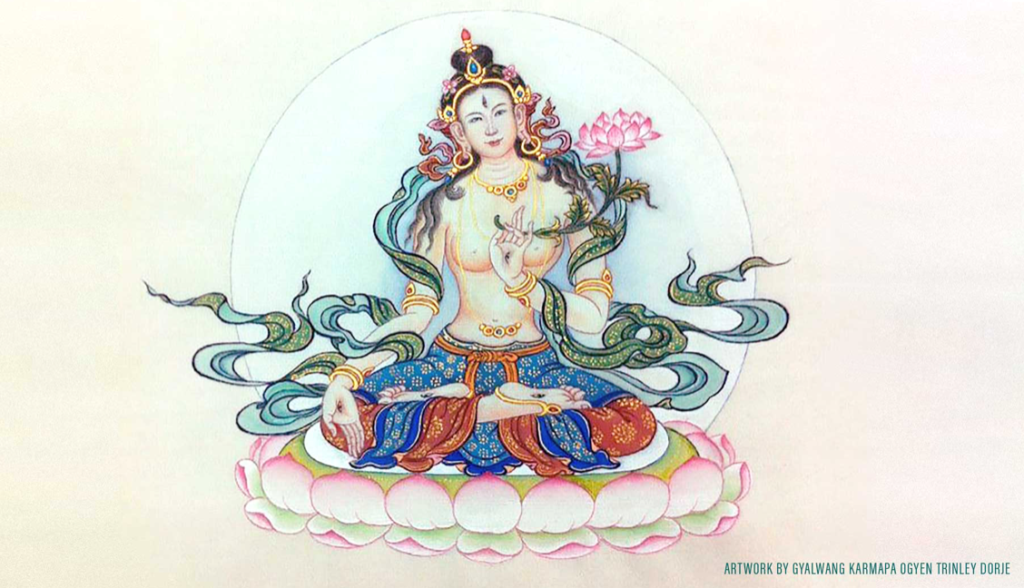
The focus of the next nyinthün will be Sitatārā, also known as White Tārā. We will be engaging in a Sādhanā practice called The Daily Practice of Sitatārā by Tai Situ Tenpé Nyinjé.
Newcomers are welcome, but please note that there is a practice requirement.*
*PLEASE NOTE: To engage in this practice of Sitatārā, one must first receive the reading transmission (lung in Tibetan) for the Sādhanā called The Daily Practice of Sitatārā by Tai Situ Tenpé Nyinjé. If you are new to this practice—in accordance with the Lineage instructions—it is requisite that you receive the lung prior to beginning the practice of Sitatārā. For those who wish to receive the lung, Lama Rabten will offer the lung in the morning, before the first Sitatārā practice session.
Schedule for December 5, 2021 (Pacific time):
9:00-10:00am Guru Rinpoche Practice
10:00-10:30am Break
10:30-12:00pm Sitatārā Practice
12:00-2:00pm Lunch Break
2:00-3:30pm Sitatārā Practice
3:30-4:00pm Break and Casual Q & A
4:00-5:30pm Sitatārā Practice followed by Mahakala Practice
The practices will be in Tibetan language with English phonetics. Liturgies will be screen-shared.
Registration and Making Offerings:
Please register and a Zoom meeting link and passcode will be send to you automatically.
This program is free, though offerings are much appreciated. To make an offering, please follow this link: https://vancouver.nalandabodhi.ca/donate/.
CLICK HERE TO REGISTER
About the Practices:
Guru Padmasambhava, also known as Guru Rinpoche (the Precious Guru), is said to be the embodiment of the guru principle, the heart of Vajrayana Buddhism. By meditating on Guru Rinpoche, we engage in merging one’s own body, speech, and mind with the enlightened body, speech, and mind of the guru; blessing the path of recognising our own Buddha-nature.
Sitatārā, (White Tārā) is one of the twenty-one manifestations of Tārā; as such, she dispels the fears of sentient beings and is swift in her compassionate activity. She is also known as The Wish-fulfilling Wheel, or Cintachakra. The meditation practice of Sitatārā is particularly associated with healing and long life, and thus one engages in her practice if one is experiencing challenges to health and longevity (or if one is dedicating to someone who is experiencing such hardship). Sitatārā is the personification of suchness, prajñāpāramitā, the ultimate emptiness nature of all phenomenon, which gives birth to compassion and relief from the negative karma experienced by ordinary beings in Saṃsāra. Renowned as the “Mother of Liberation,” or “Mother of all the Buddhas,” Sitatārā expresses maternal compassion, just as a mother does for her children, and offers healing to beings who are hurt, sick, or wounded; to overcome physical, mental, and emotional suffering.
Mahakala is the main Dharma Protector of the Karma Kagyu Lineage of Tibetan Buddhism. By practising Mahakala we eliminate outer, inner, and secret obstacles in our Dharma practice and develop the capacity to benefit ourselves and others.
About the Teacher:
Lama Rabten’s dharma education started at a very young age and he spent his early years training at Rumtek Monastery, seat of Gyalwang Karmapa in Sikkim, India. In 2000 he completed three-year retreat at Pullahari Retreat Centre in Kathmandu, Nepal, under the guidance of Drupon Khenpo Lodro Namgyal, Bokar Rinpoche, Tenga Rinpoche, and Khenpo Tsültrim Gyamtso Rinpoche. To serve the Nalandabodhi community, Lama Rabten came to Canada in 2002 under the invitation of Dzogchen Ponlop Rinpoche. Lama Rabten is now the resident teacher and spiritual director of Nalandabodhi Canada. He is fluent in several languages, including Tibetan, Mandarin, and English and he teaches and supports Nalandabodhi students throughout Canada.
Thank you all and we look forward to practicing together!
Sarva Mangalam
Date/Time
Date(s) - Sun., December 5, 2021
9:00 am - 5:30 pm
Location Nalandabodhi Vancouver – Online


